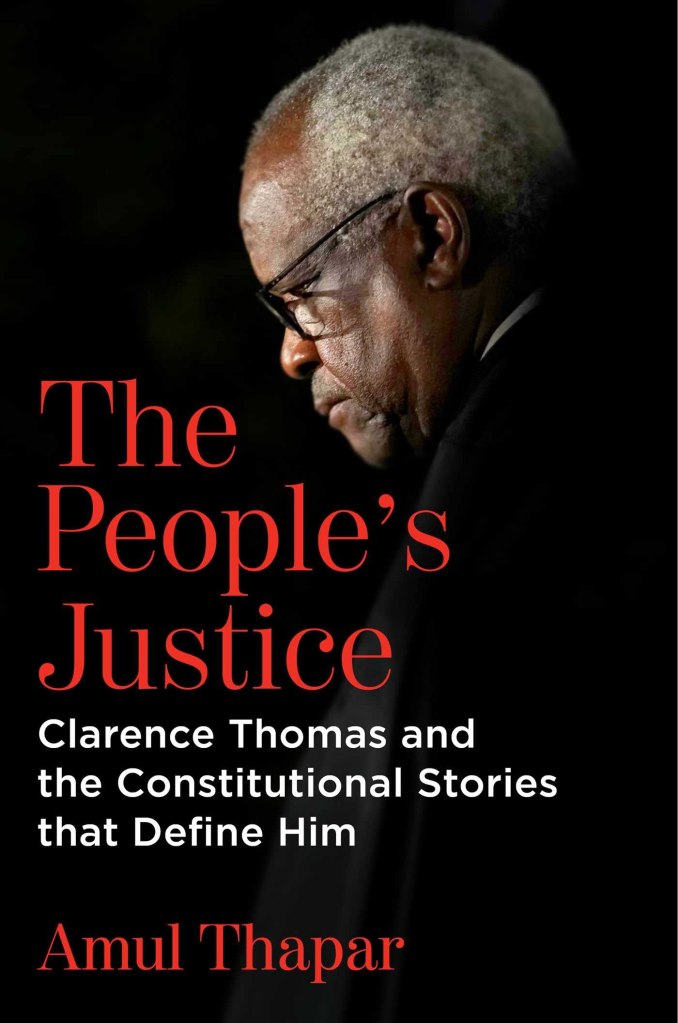
I was looking for a good biography on Justice Clarence Thomas and thought I had found it in the latest book about him “The People’s Justice” by Amal Thapar. Actually, once I started reading the book I discovered it was not actually a chronological biography but an analysis of twelve Supreme Court cases for which he was involved in the decision and authored an opinion. The book illustrated how Justice Thomas brought an originalist viewpoint to his decisions. In other words, he believed that the constitutional text ought to be given the original public meaning that it would have had at the time that it became law. Thomas shows himself to be a brilliant, articulate and fair judge of cases even though most of the opinions presented were written on cases that he was in the minority.
Thomas’s biographical details are only briefly stated at the beginning of the book with the rest of the book being an analysis of the cases presented. After his father abandoned the family, Thomas was raised by his grandfather in a poor Gullah community near Savannah. His grandmother taught him that there is nothing you can’t do if you put your mind to it. He went on to attend Holy Cross and the Yale Law School and ultimately to be appointed by President Bush to the Supreme Court in 1991. Thomas is a very “down to earth” person that knows everyone’s name in the Supreme Court building.
Amul Thapar sits on the U.S. Court of Appeals for the Sixth Circuit and is widely viewed as a top contender for a future Supreme Court appointment. He identifies Justice Thomas as “the most powerful originalist voice of our day” and contends that “when we actually follow the original meaning of the Constitution, the weak and the politically powerless stand to benefit the most.” In each case presented, Justice Thomas upheld the original meaning of the Constitution, even when altered by years of bad decisions. Most importantly, in each case he sided with the plight of the average citizen who was hurt by government or corporate bad faith. The case reviews focus more on the participants’ stories than the justice’s reasoning.
I found the case discussions very interesting and the State Farm fraud case discussion alone is worth the price of the book. There are many other good biographies of Justice Thomas out there but I highly recommend this book that gives a clear viewpoint of the judicial philosophy of one of the great legal minds of our time.
Discover more from The Conservative Christian Apologist
Subscribe to get the latest posts sent to your email.
