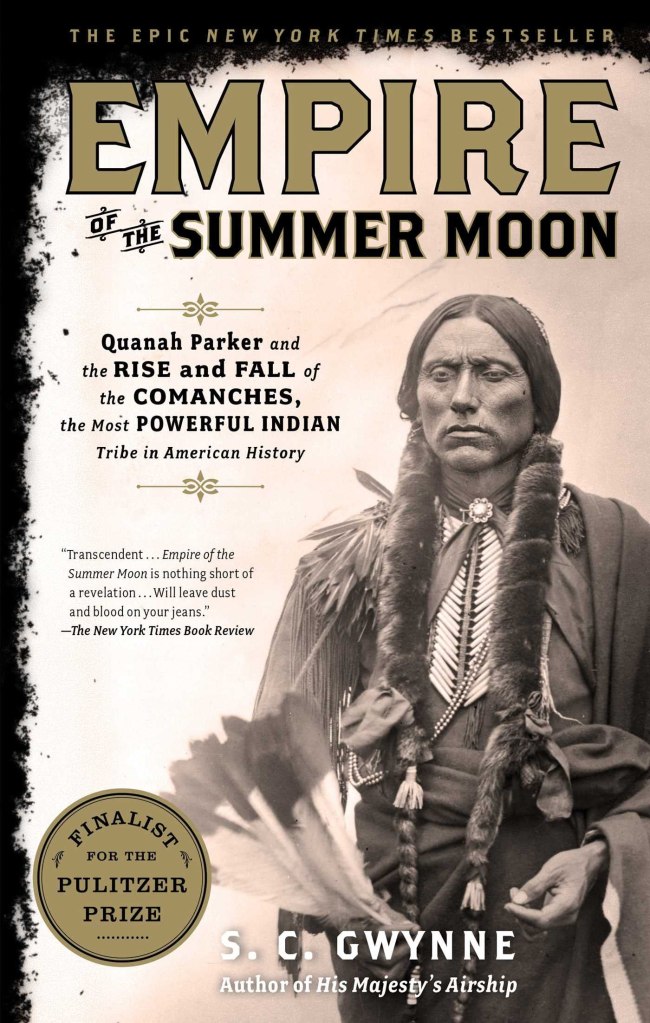
“Empire of the Summer Moon” is a book written by S. C. Gwynn primarily about the Comanche Indian nation. The book also discusses the story of Cynthia Anne Parker and her son Quanah Parker who was one of the last chiefs of the Comanches. The book describes the history of the warlike and vicious Comanches and focuses on the settlement of the Comanche land (American Plains including western parts of Texas, New Mexico, Colorado, Kansas and Oklahoma called Comancheria), by American settlers in the mid-1800s. Cynthia Anne Parker was part of a group of some of the first settlers on formerly Comanche land and was captured by the Comanches in a raid. She lived with them for over two decades eventually marrying one of the chiefs (Comanches had more than one chief as they moved in separate nomadic bands). She was eventually recaptured and returned to her surviving family where she died only a few years later, never able to reorient herself to non-Indian life. Quanah after ferociously fighting the settlers for many years finally surrendered in 1875 and moved to the assigned reservation and ended up adapting well to “civilized life”, although most Comanches did not.
The Comanches were one of the most powerful Indian tribes as they were expert horse riders and warriors and had conquered Comancheria from other Indian tribes before the Americans arrived. They held out against the American settlers and armed forces (regular military and various militia/ranger units) for several decades. After the Civil War however, the government sent increasing numbers of troops with sophisticated weapons, such as repeating rifles and cannons, which finally subdued the Comanches and forced them on the reservation.
There was no one to root for in this book. On the one hand you had Indians who were barbaric, thieves, dishonest, rapists and murders against American settlers who were murders, dishonest, racist and greedy. The Americans stole the Comanche land from them, it is estimated they broke 378 treaties with Indians in total, but the Comanches had stolen the same land from other Indian tribes in years past.
Personally, I did not like the writing in this book which went back and forth from story to story without a clear steady chronological procession of the story, which I would have preferred. However, this seems a minority opinion as this book is generally very highly regarded and was nominated for a Pulitzer Prize. The book gives many interesting side stories about the history of the Texas Rangers, the development of the six-shooter, and the destruction of the buffalo herds. I would recommend this book for anyone who is interested in the old American West, particularly the Indian Wars.
Discover more from The Conservative Christian Apologist
Subscribe to get the latest posts sent to your email.
