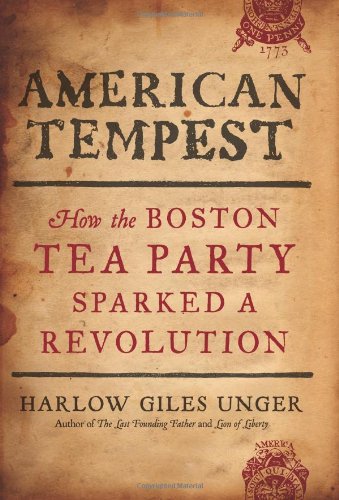
“American Tempest – How the Boston Tea Party Sparked a Revolution” by respected historian Harlow Giles Unger gives a balanced account of the beginnings of the American Revolution that led to the Boston Tea Party. While describing the British arrogance, naivete’ and disastrous tactics that were used by certain revolutionaries to inflame the colonists, it also discusses the unrelenting anger of Samuel Adams and James Otis, leaders of the Sons of Liberty and other revolutionaries. This anger sprang as much from personal failure (Adams) and mental illness (Otis) as love of liberty. Adams is described as a disheveled, foul-mouthed, liar and embezzler, that could not hold down a proper job due to his revolutionary activities which kept his family in abject poverty. A relentless agitator, Adams cultivated Boston’s underclass, provoking rampages of looting, arson and tarring-and-feathering persons who disagreed with him and for which he went unpunished. He also convinced more moderate, wealthy figures such as John Hancock to back the Sons due to it benefiting his financial interests.
Unger stresses that “taxation without representation” was an afterthought. The colonists hated all taxes as many of the colonists were getting rich while Britain’s finances were greatly suffering due to spending on troops and government officials to protect and administer the colonies. Most of the imposed taxes were modest or even nominal and the amount of the taxes were not unreasonable to cover the colony’s costs. Due to the colonists pushing back on the taxes, smuggling in and boycotting British goods, Britain quickly removed all taxes except for a small tea tax of three pence a pound which Adams used to incite the Boston Tea Party.
The chapter on the earlier Boston Massacre was particularly disgraceful for the revolutionaries. Sam Adams incited rebellious colonists to harass British Soldiers and certain loyalist colonists (there were many) even having their children throw snow balls at the soldiers. One child was eventually killed after he was in a group that pelted a loyalist store owner with sticks and dirt and drove him back to his house where he shot randomly into the crowd to defend himself. This led afterwards to the Boston Massacre which was incited by Adams as certain “patriots” surrounded British soldiers. They verbally abused and hit them with clubs, stones and snowballs. As the people kept attacking the soldiers eventually fired killing three people. At a subsequent trial the soldiers, defended by John Adams, were largely acquitted (two were convicted of manslaughter with mitigating circumstances which produced only a branding on one of their fingers). The patriot’s witnesses were revealed as purgers bribed to do so by some of the wealthy rebellious colonists. Unger states the trial unmasked Sam Adams as a “sinister power hungry plotter willing to sacrifice innocent lives.”
This is a book I highly recommend because it gives a much more balanced account of the founding of our country than we often get to hear. Far form the tale of noble patriots striking a blow for liberty, Unger portrays the American rebels, as well as the broader march to revolution, as deeply rooted in economic self-interest, smuggling networks, personal vendettas, mob violence and political opportunism. Unger does not shy way from discussing the rebels tar-and-feathering, property destruction, intimidation of moderates, and “reign of terror” in parts of the colonies, particularly in Boston. The book points out the irony that post-revolution the American state and federal governments imposed much heavier taxes than the British ever proposed, leading to events like Shays’ tax Rebellion in Massachusetts which was brutally put down by the some of the same people who raged against much more moderate British taxes. Samuel Adams warned would be American tax protestors that “the man who dares to rebel against the laws of a republic ought to suffer death”.
Discover more from The Conservative Christian Apologist
Subscribe to get the latest posts sent to your email.
